
 All articles
The chess board that refuses war

Elizabeth Markevitchfounder of ikonoTV
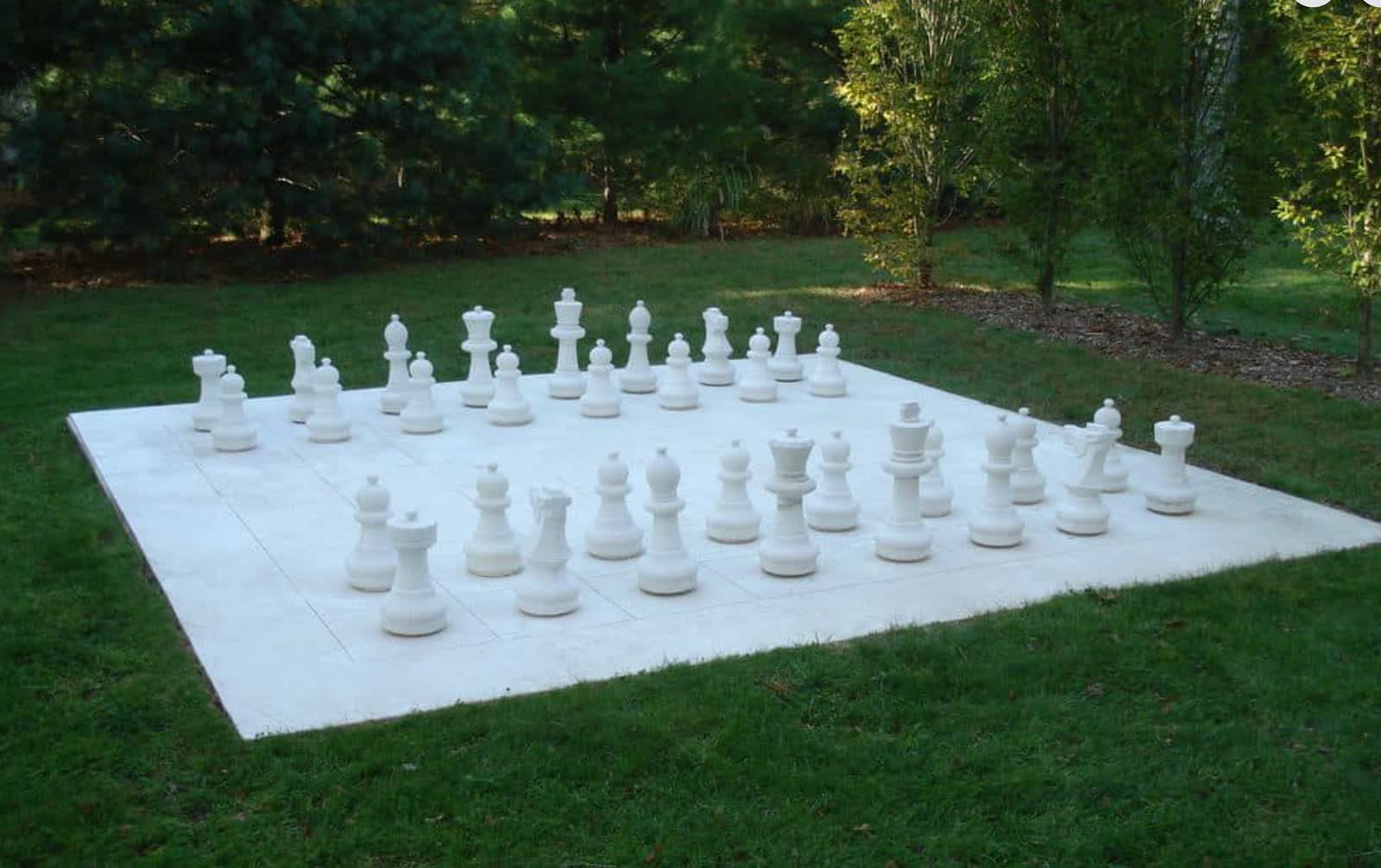
Yoko Ono “Play it By Trust” 1999 Marble dust, concrete. Permanent Loan, courtesy of the artist, 2008. LongHouse Reserve in East Hampton, Long Island, NY
All squares white.
All pieces white.
Two players, one memory.
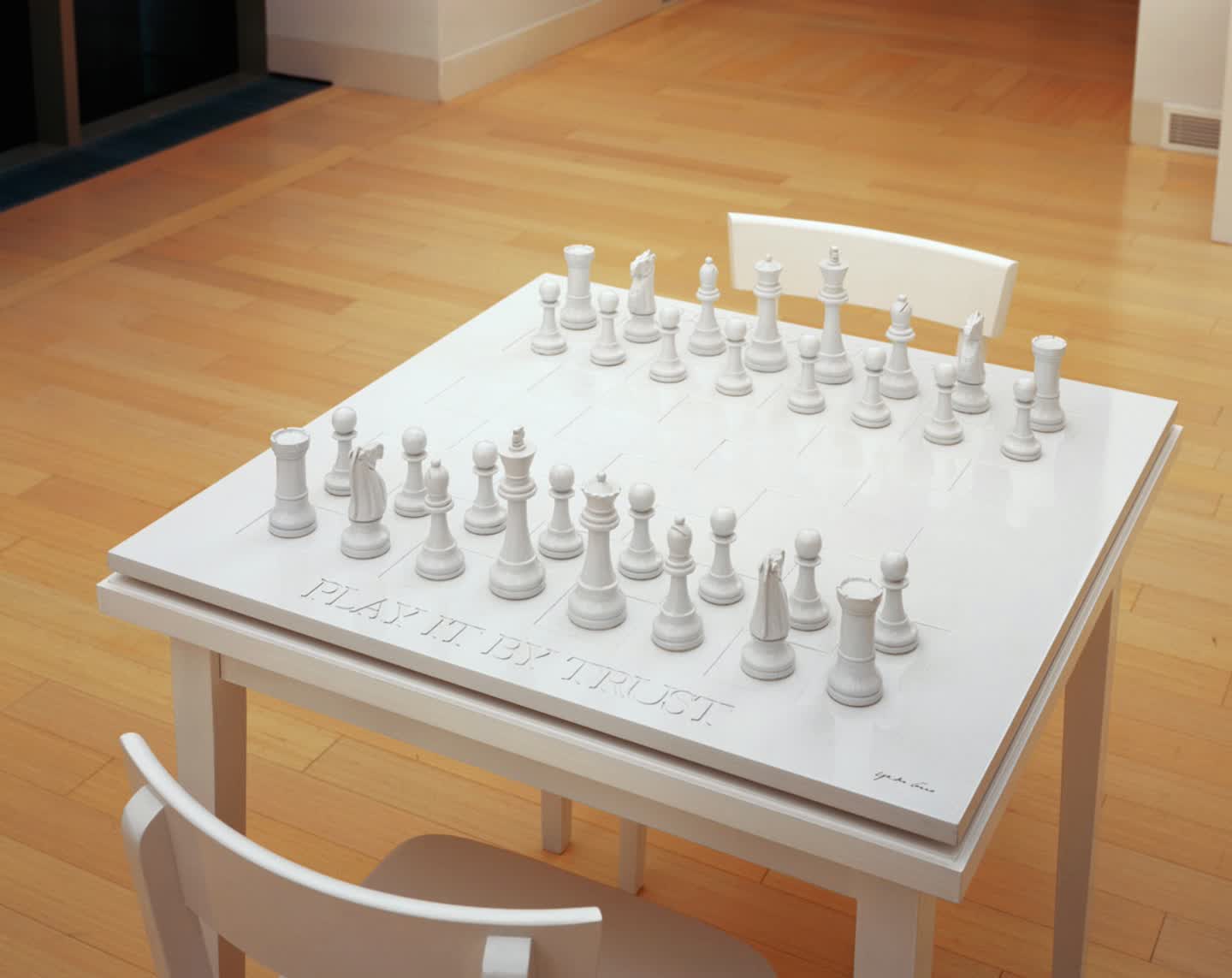
Yoko Ono’s White Chess Set, later titled Play It By Trust, does something subversive and beautifully simple: it dissolves the visible boundary that makes a game a fight. No black. No “other.” Just a field where, after a few careful moves, nobody can quite remember which army is theirs. How do you win when you can’t tell where “you” end and “they” begin?
At the end of the day, this is not a clever novelty. It is a working model of peace.
A small table in 1966, a large question for us
The work first appeared in November 1966 at London’s Indica Gallery, part of Ono’s instruction-driven practice aligned with Fluxus. Her chess set changes the rule of recognition, suddenly, play relies not on force but on memory, communication, and trust. Over the years, the piece has been re-presented in multiple formats: long tables of boards, outdoor versions, and museum installations where visitors are invited to sit and try. Try, and inevitably, lose track.
How it works, and why it breaks
Traditional chess depends on contrast. Black/white squares guide orientation; opposing colors distinguish allegiance; tactics rely on clear separations. Ono erases that visual code. Strategy turns to cognitive load: you must remember more than you can reliably track. Very soon, you don’t know which knight is yours. The gameplay “breaks.” But the encounter begins. Museums describe this breakdown as intentional: a metaphor for the futility of war and a nudge toward the aspects of humanity that unite rather than divide.
This is a design decision with social consequences. Once color, our symbol for sides, disappears, we are forced to talk. “Was this bishop yours?” “Where did my pawn start?” We create ad-hoc protocols, new agreements, gentle compromises. The “rules” migrate from the board to the relationship.
From “war game” to cognitive infrastructure
We often treat art as a luxury, something we visit on weekends if the line isn’t too long. Ono’s set insists on another story. Here, art behaves like cognitive infrastructure: a tool for practicing the mental moves we need in complex, polarized systems. It quietly trains three muscles we underuse in public life:
- Trust over surveillance. We stop policing each other and start remembering together.
- Dialogue over dominance. When the win/lose binary dissolves, “success” becomes mutual navigation.
- Creative rule-making. If standard rules no longer fit, we write humane ones in real time.
At the museum, this looks like two strangers leaning in and laughing at their amnesia. In a city council or a startup or a classroom, it looks like reframing negotiations from opposing trenches to shared problem-solving.
“Isn’t it just a gimmick?”
Skeptics sometimes roll their eyes at conceptual interventions. But Play It By Trust is not a pun; it is a performative condition. Contemporary Art Museum St. Louis called it a metaphor for the futility of war: by eliminating color-based opposition, Ono “dooms any attempt to successfully ‘play’ the game beyond a series of initial moves.”
If a rule produces harm, change the rule. If contrast produces conflict, reduce contrast. Ono compresses this political philosophy into a tabletop.
Set up public Play It By Trust tables in lobbies, libraries, and parks as micro-rituals of cooperation. Pair with facilitation prompts: “When did you stop knowing whose piece was whose? What did you do next?”
This is not a museum trick. It’s a governance rehearsal.
A fair counterpoint: opposition can sharpen ideas. True. Chess itself is a magnificent engine for strategy. Ono doesn’t cancel chess; she tilts it. She offers one more tool for our kit: a designed condition where strategy gives way to co-navigation. The world we’re trying to fix is already hard enough; we don’t need extra borders to stage a fight. Sometimes the right move is deleting the line.
Not to make things prettier.
To make them work better.
And then, almost always, you look up at your partner and smile the smallest political smile: let’s just agree to keep going.
If you erase the border and still want to fight, you must draw the border again.
If you can’t remember which side is yours, maybe the side is us.
PS: so if you want to try playing, go to LongHouse Reserve, East Hampton, NY, and ask if you may. M+ Hong Kong, mumok in Vienna and Ludwig Museum in Budapest each own a version too, but call before you go…