
 All articles
Ten seconds of silence
Dimitris Kokkinias called it the distance between nature and us. A face in the bark of a tree can close it.

Elizabeth Markevitchfounder of ikonoTV
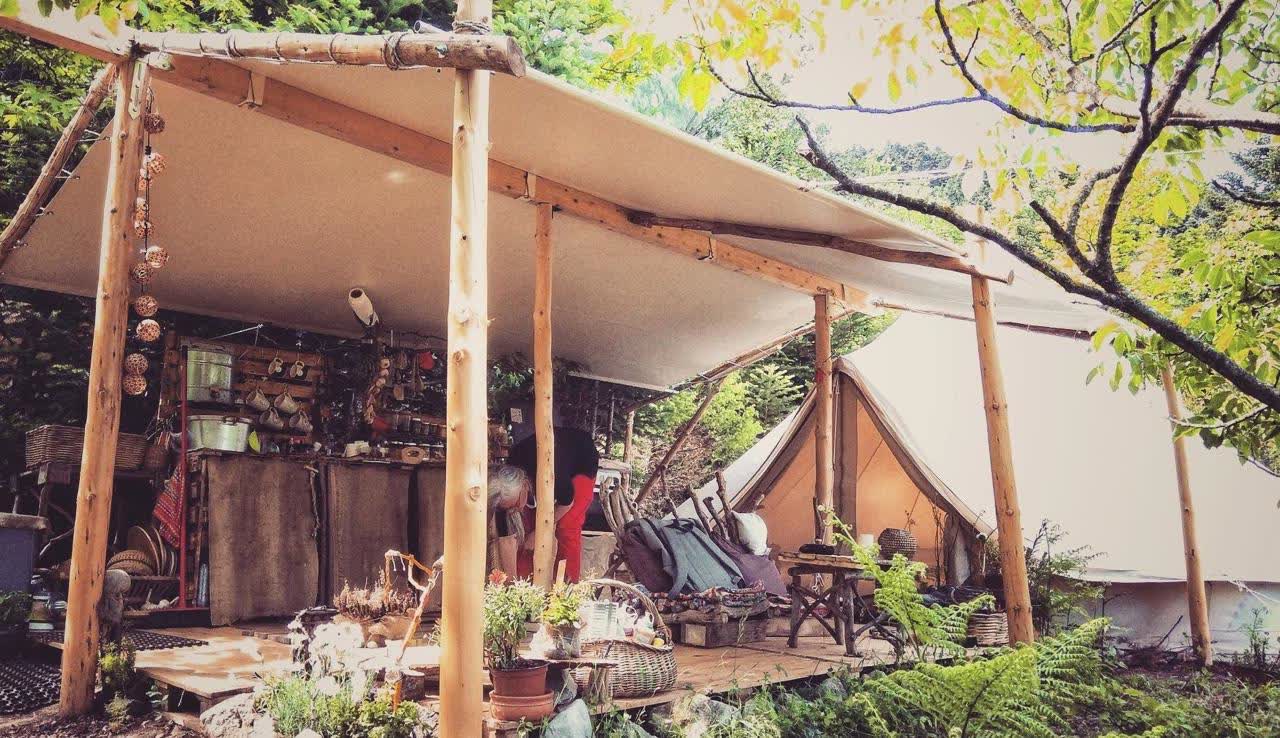
Dimitris Kokkinias’ home in the forest at two hours of Athens
A few days ago I was at the New Eleusis Symposium organized by the World Human Forum, and after three intense days, they came up with a very special guest: Dimitris Kokkinias. He arrived on stage and just didn’t do anything for 10 seconds, which, of course, we all know is not a lot in an ordinary day. But when you’re waiting to find out what the guy on stage is going to tell you, it feels long, and the room was really waiting for him to start.
Then he said, “That is the distance between nature and us.” Kokkinias is Greek, and I have to admit that I had never heard of him, because almost everything he does online, on YouTube or in writing, is in Greek. He co-founded Softening & Healing, which is a meditation and healing practice in Athens, and he spoke about healing through nature during the panel.
Squirrels and Fireflies
For the last 10 years, he and his wife have spent much of their life in the forest, 2 hours from Athens, living in a tent. Squirrels during the day, fireflies at night, as he said. He said that sometimes he even talks and sings with the birds.
There Is No Nature
His first claim could sound like a provocation, because he said there is no nature. He explained that when we say, “Let’s go out for a walk into nature,” we are already saying that nature basically lives somewhere else, that it’s at the end of a road, a drive, and that we are only there to visit. He pointed out that even the Oxford Dictionary defines nature as the physical world, as opposed to humans or what humans make. The separation is really in the definition, and it comes back to all my work: like him, I really want people to feel, not to use words. Obviously, words are not helping here.
The Wolf Does Not Google
From there, his argument moves quickly. If nature is over there and we are over here, there is a conflict with creation itself, as he put it, and you can’t be healed from what you are fighting. It’s just not possible. Healing for him is not a struggle and not a battle plan. It is the moment you experience that you are nature too, one nature and one cosmos. In creation, he said, there are opposites, but no opposition. Nothing in the forest struggles to fix something which is not working. If a wolf has a broken leg, it does not Google its symptoms. It finds a hollow under a root, lies still and stays there as long as it takes. Most of us with a sore knee are on our phones immediately.
Then he shared with us a short trailer from a David Attenborough film made during the COVID lockdown, when people stopped, basically everything stopped, and nature recovered very quickly. He said that what really remains is peace, and in that peace, nothing is asked of you, not even to be cured.
So then came the question: “Who brings the war inside of us?” He argued that it’s not other people or circumstances, but just our mind. Apparently, he wrote a whole book to say just one thing: that the mind is the source of our suffering. It became a bestseller in Greece because so many people find themselves in its pages.
A Nest Under an Old Tree
Then, instead of a conclusion, he led the room in a meditation. He asked us to feel our breath. “Don’t change it, just welcome it. Imagine a circle around you, with you at the center. This is your nest, your real home. Sit under a huge old tree and do nothing and want nothing.” “It’s the breath that breathes,” he said, “not your name, not your nationality or your gender.”
Then he invited us to put our right hand on the left arm and the left hand on the right arm, or both hands on the belly, and then to ask ourselves, with care and warmth, “How are you?” and just listen.
Leonardo’s Damp Walls
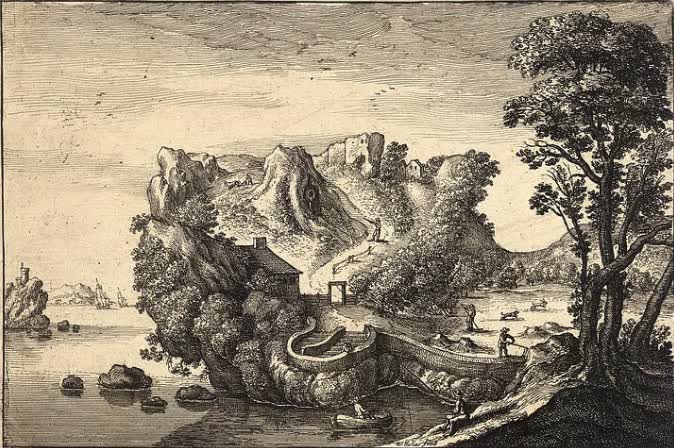
Writing this, I came back to Leonardo da Vinci. In his notes on painting, he gives his students a strange piece of advice to wake up their invention: look at walls stained with damp, or at stones of mixed colors, and maybe, if you half close your eyes, you will recognize in them landscapes, battles, strange faces and figures. He compares it to the ringing of bells, where you can hear any name or word you would like. He was talking about walls, but the spirit of it sends us outdoors, to bark and rocks and clouds, which he studied and wrote about at length.
Today we have a word for this: pareidolia. Funny enough, it is Greek, para and eidolon, “beside the image.” Although the word was coined long after Leonardo, in the 19th century, pareidolia is the reason you see, for example, a man in the moon, a surprised face in the front of a car, or a grumpy old man in the trunk of an oak tree.
Something Looks Back
This is where Dimitris and Leonardo meet, at least for me. When you see a face in a cloud, the gap he measured in 10 seconds closes for a moment. You are no longer looking at nature from the outside, the way you would when visiting a museum. Something out there is just looking back, and your mind insists it is one of us. For once, the mind, the troublemaker in Dimitris’s story, is doing us a favor here.
The next time you are outside (not in nature, since you never left it), look for a face in the bark of a tree or in a rock by the path, and when you find it, say hello. You will be connected.