
 All articles
Steps, Sleep, Calories, and Nothing
We log everything the body does while we are not paying attention. Never once what any of it did to us.

Elizabeth Markevitchfounder of ikonoTV
Photo Marius Gire
Most of us now keep track of ourselves without ever deciding to, because the devices do it for us. My phone counts my steps and reads my heart rate. The WHOOP on my wrist does more than that. Heart rate, respiratory rate, how long I slept, how much of it was deep sleep, how much was REM. It will take an electrocardiogram and a blood pressure. It tells me how much stress I was carrying at work, and it keeps a note of how long I spent on my breathwork.
Funny enough, these are all external ways of measuring what is inside, things I would not be able to tell you myself. Which is great. A few years ago I would have had to go to a doctor for most of them, for the electrocardiogram, for the blood pressure. Now they arrive on my wrist overnight, and nobody finds that strange.
In my last article I wrote about EEGs and heart rate, and about the researchers who use them to find out how we react when we are standing in a museum or sitting in a concert hall. They are reading us at the level of neurotransmitters and a heartbeat, and I think it is fascinating that the work exists. The strap on my wrist is a smaller cousin of that machinery. Nobody put this one on me. I bought it myself.
And all of these measurements, fascinating as it is that they exist at all, still do not tell us how we feel.
Two evenings, and no record of either
The German Pop Band Rainbirds have been going forty years, and this was the anniversary tour. I went three times. Düsseldorf in December, Berlin in May at the Admiralspalast, and an open-air at Frankfurt an der Oder. They played the old hits from the nineties, and every one of them put me back into the moment it belongs to. My favourite song is Sea of Time, where I could feel totally light. Then I went home, and yes, I told some friends about it. That is the entire record of those three evenings.
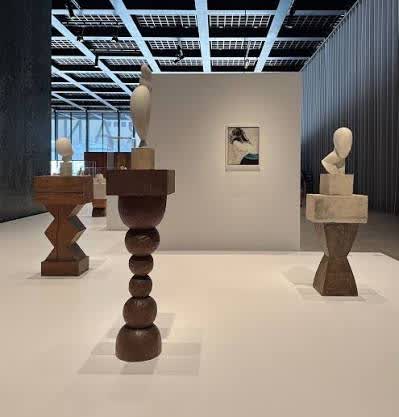
Last week I was at the Neue Nationalgalerie in Berlin, at the Constantin Brancusi retrospective. Even though I was seeing some works that I sold in the past, there were others I knew by heart from museums, and seeing them all together in that Mies van der Rohe building moved me again. What moved me most was not the famous sculptures but some of the photographs, and the bases he made to stand the sculptures on.
In a few years I will still remember exactly what I felt in those rooms. I have no record of any of it.
So what do I do with it
I can tell you all of it afterwards. I loved it, I did not like it, this is what it touched and this is why. And I did tell my friends.
But what do I do with that? Can I track it? Can I keep it? How am I keeping track of all this? Maybe writing a diary.
Where would it even go
Look at the list again and notice what every item on it has in common. Steps, sleep, heart rate, respiration, calories, blood pressure, the electrocardiogram. Every one of them is a reading of the body as an engine. What it burned, how hard it ran, how well it recovered, whether it shut down properly at night. It is a very good dashboard, and I look at it every morning. It followed me to three concerts and a retrospective. Not one line of it is about a room in Berlin.
Somebody will write to tell me the field exists. It does. The newer phones will let you log a state of mind. You open the health app, you find it, you choose whether you are reporting a single moment or a whole day, you drag a dial from very unpleasant to very pleasant, and then you pick your word from a list. Content, indifferent, overwhelmed, peaceful. None of those is the word for what Sea of Time did to me.
And there is something about that field I was slow to see. It is the only one on the whole device that I have to fill in myself. I have spent twenty years arguing that what art does to people should be counted, and I wore the gap on my own wrist for years without noticing it.
Everything else arrives on its own. The steps count themselves. The heart rate is taken off my wrist while I am thinking about something else. The sleep report is compiled while I am unconscious, a measurement of me that needs me to be absent. None of those readings needed me for anything. I did not have to be paying attention, and I did not have to be awake.
Feeling is the only reading the machine cannot take by itself. Everything else was taken. The one thing missing is the one thing that has to be given. So the field sits there, empty, on almost every phone that has one.
What the box office knows
And if I cannot keep it, the institutions certainly cannot.
They are a bit trapped. The only thing they can really measure is the number of tickets sold, which will show how good their marketing was, but it is not telling them whether the people were happy. The Neue Nationalgalerie knows I came. It has no idea about the bases.
I am not asking anyone to invent an appetite for this. Millions of us already measure ourselves every day, unpaid and unpersuaded, for years, because it costs almost nothing and tells us something we care about. The appetite was never the problem.
It does ask something of us, though. It means being willing to express it, and to keep track of our own emotions, without going into a long philosophy essay about the why and the what. Just tracking.
So, a question to the people who run the museums, the concert halls, the theatres and the operas, and to the researchers sitting beside them. Did you find a way to track this, which is not a survey? I do not have one either. I went to three concerts and a retrospective in the last year, and all I have is what I said to my friends on the way out. If you have found something, or tried something and abandoned it, I would like to hear about it.
Every number is about the machine
Now read the list again and notice what every item has in common.
Steps, sleep, heart rate, weight, oxygen, temperature. Every single one is a reading of the body as an engine: what it burned, how hard it ran, how well it recovered, how efficiently it shut down at night. As a dashboard for an engine, it is remarkable. Twenty years ago you would have needed a clinic for half of it.
And not one of those numbers has anything to say about the day you actually had.
You can come out of a cinema wrecked by a film, sit on the bus without saying anything to anybody, sleep your eight hours and score ninety-four. The watch will congratulate you in the morning. It has no way of knowing what the evening was, and no place where you could tell it.
The one you have to fill in yourself
Now, before anybody writes to correct me: yes, the field exists. The newer phones will let you log a state of mind. You open the health app, you find it, you choose whether you are reporting a single moment or a whole day, you drag a dial from very unpleasant to very pleasant, and then you pick your word from a list. Content. Indifferent. Overwhelmed.
So it is a score and a word, which are the two things this series has already spent two pieces explaining that feeling does not fit into. But leave the design aside, because something else about that field matters more.
It is the only one on the entire device that you have to fill in yourself.
Everything else arrives on its own. The steps count themselves. The heart rate is taken off your wrist while you are thinking about something else entirely. The sleep report is compiled while you are unconscious, which is the purest version of the thing, a measurement of you that requires you to be absent. Not one of those readings needed your attention, your effort, or your presence in the moment.
The feeling is the only reading the machine cannot take by itself. Everything else on that phone was taken. The one thing missing is the one thing that has to be given. And so the field sits there, empty, on almost every phone that has one.
Nobody decided this out loud
The official reason feeling is not on the list is that it cannot be measured. Too subjective, too slippery, too personal, not really data. I have heard that sentence in rooms full of clever people for twenty years, and it always arrives with a small apologetic shrug, as though it were a law of physics.
Then look at what we tolerate everywhere else on the dashboard. The calories your watch burns for you are the output of a model, not a measurement. We accept that cheerfully, we compare the number with our friends, and some of us rearrange our lives around it.
So precision was never the bar. We have been perfectly content to count things we can only approximate, as long as counting them costs us nothing. Feeling was left off the list for a different reason. Taking it requires the person to be awake, present, and asked, and every other number on that phone can be had without any of that. It looks like a technical limit, and it was a decision about what is convenient to collect, made by nobody in particular and never once put to us.
The visit your phone recorded
Which is where this stops being about wrists.
Think of the last time you came out of a building changed. A concert, a play, a room of paintings, whatever yours was. Your phone has a record of that evening. The steps across the galleries, the floors climbed, the minutes in motion and the minutes standing still, the route on a map, the time you left, very likely the price of the ticket. It has everything about the visit except the visit.
And when you got home, there was nowhere to put the rest of it. Not on the phone. And not, as I wrote last time, on the form the institution might send you either, which will want to know whether the work was well thought through and put together. Two instruments aimed at the same evening from opposite ends, both of them good at their jobs, and the only thing that actually happened to you falls straight down the gap between them.
And I have been reading that score for years, and it took me an embarrassingly long time to notice that the thing I do before coffee is the answer to the thing I have been arguing about in public for twenty years. Every one of those wrists, mine included, is evidence that people will measure themselves every single day, unpaid and unpersuaded, for years, as long as it costs them almost nothing and tells them something they care about. The appetite is not the problem. It was never the problem.
So a question to the people who run the museums, the theatres, the operas and the festivals, and to the evaluation leads and audience researchers beside them. Everybody who walked into your building last night is already measuring themselves, and so am I. They will read last night’s sleep before they read anything else this morning, and nobody had to talk any of us into it. Is there anything in your building they could have recorded about their own evening, with that same fifteen seconds of effort? If you have built something like it, or tried it and given up, I would like to hear what happened.