
 All articles
Monet stopped trusting his eyes
Claude Monet, nearly blind, kept painting after a lifetime watching light. Then he went by the name on the tube.

Elizabeth Markevitchfounder of ikonoTV
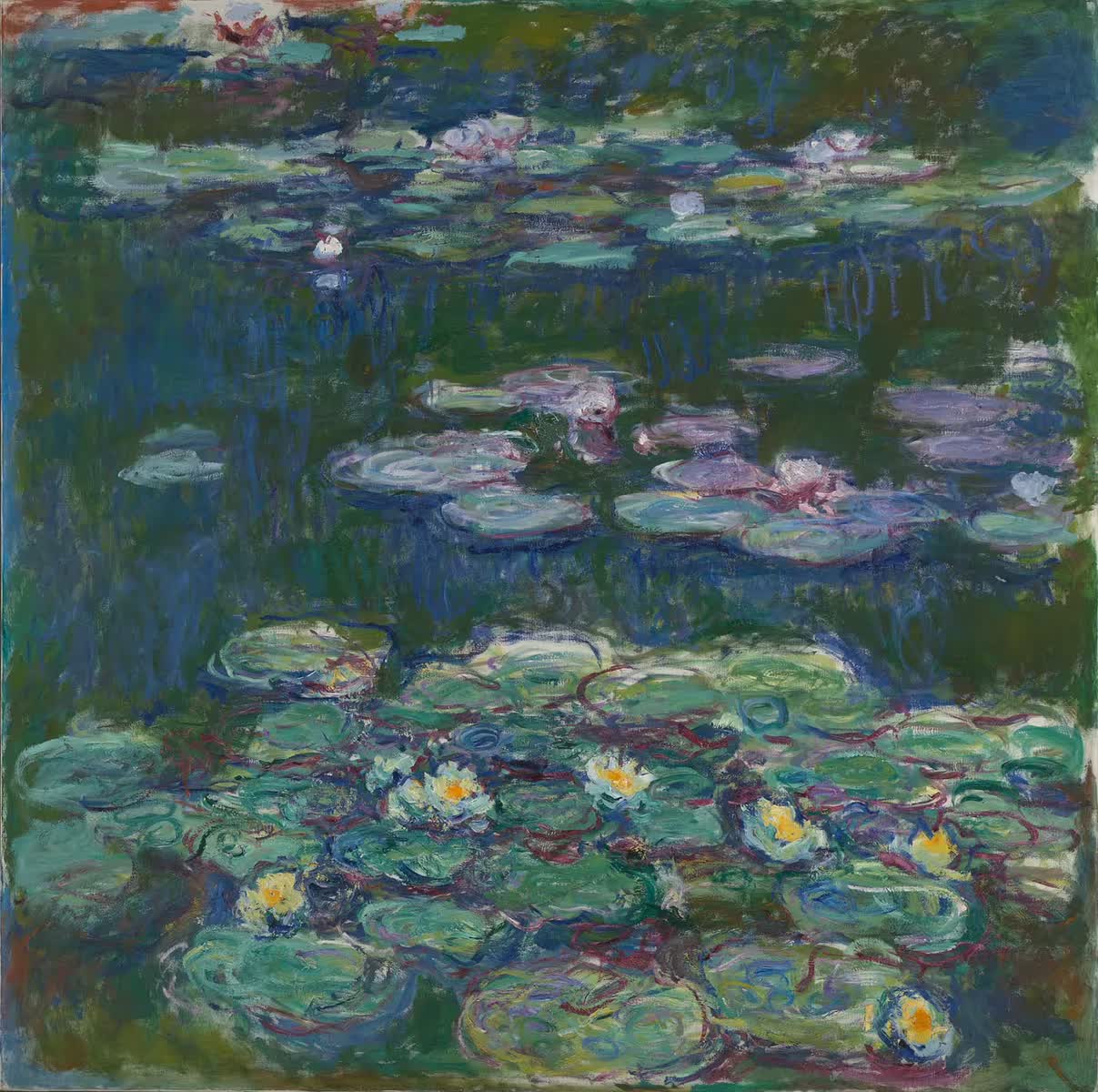
Kunstmuseum Winterthur, Claude Monet, White and Yellow Nymphéas,1915
There is a story about Claude Monet that stays with me. It is not the one about the garden.
In his last years, he could no longer trust what he saw on his palette. So he labelled his tubes of paint and kept the colours in a strict order, always in the same places. Around 1920 he showed the great canvases to Thiébault-Sisson and explained how he had managed. He said he had got his sense of colour back by adapting his way of working to his eyes. Most of the time he laid the colour down haphazardly, trusting the labels on the tubes and his habit of where each colour had always sat on the palette.
A man who had spent a lifetime watching light change was going by the name on a tube.
It would be nice to say that he simply painted what his eyes showed him, and that the strange late colours are the world as he saw it. He told it differently. He knew his eyes were wrong and he painted anyway, from labels, from habit, from memory. He painted colours he could not see, on trust. If you stand in front of one of his late canvases, that is what you are standing in front of.
A little of what he loved
The trouble began around 1908, mostly in the right eye. In July 1912, at 71, he wrote to Gustave Geffroy that he could no longer see with it. That summer he was told it was cataracts. He had them in both eyes.
A doctor in London advised surgery in 1913. Monet refused, because Daumier and Cassatt had done badly after theirs. He said he would give up painting altogether, if that was the price, so long as he could still see a little of what he loved.
He did not give up painting. In 1914, just after losing his son, he took up the great scheme of the Water Lilies, and built a huge studio for it at Giverny, which he complained was ugly. Reds looked muddy to him, pinks insipid, blues hard to see. Yellow took over and everything darkened. And still, he kept painting.
By 1922 the eye doctor Charles Coutela found that the right eye saw only light and the left a tenth of what it should. That April Monet signed a contract for nineteen panels.
Very beautiful
That August he wrote to the dealers Bernheim-Jeune that he saw everything in fog. Then he added, as Richard Kendall’s Monet by Himself gives it: “It’s very beautiful all the same”. He went on to say he wished he could have painted it.
A man losing his sight looks at his fog and finds it beautiful.
The operation
In 1923, at 82, he gave in. Between January and July Coutela operated on the right eye three times. Monet lay flat with sandbags to keep him still, and he was a difficult patient. Afterwards he wrote to Coutela that he regretted it, and that it was criminal to have left him in this state. He refused to have the left eye touched.
Some of his sight did come back. Everything looked too yellow at first, then by the summer of 1924 too blue. His two eyes no longer agreed. He told Jacques Mawas, the doctor who fitted his tinted lenses, that he saw blue, that red and yellow had gone, and that he still remembered those colours well.
And then he could see what he had done. He destroyed some of the canvases from before the operation and retouched others. He had destroyed work before, so the gesture was not new. But think of looking at years of your own painting and finding out what colour it was.
How much was choice
Did his eyes make those late paintings what they are? Medical writers tend to say yes. Ravin, who wrote the first full study of it in English, warned against treating eye disease as the cause of a style. In 1923 the dealer Joseph Durand-Ruel said Monet could no longer see or judge colours, and in 1939 Lionello Venturi called the Orangerie panels the gravest mistake of his art. In 1952 André Masson called the same rooms the Sistine Chapel of Impressionism.
The eyes changed the work. How much of it was choice, nobody can say, and I would rather leave that open than tidy it up.
Two rooms
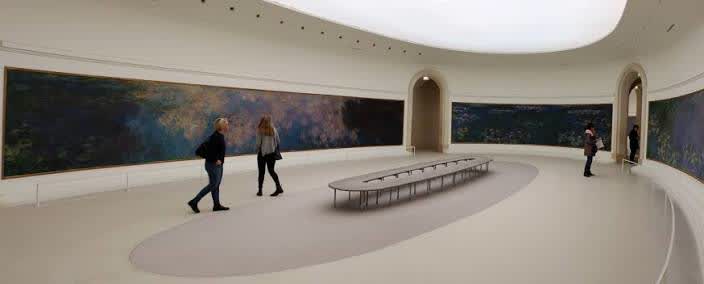
He died in December 1926, at 86, and he kept the panels until the end. They opened at the Orangerie five months later, in two oval rooms with daylight from above. Today there are benches in the middle. He wanted water on every side of you, with no horizon and no edge to it.
In 1968, during May ‘68 in Paris, I went to Paris with my mother, and I was discovering Paris really for the first time, at least consciously. We did some museums, which were really not easy to do because of the revolution happening at the time. This is where I discovered the Musée de l’Orangerie.
I still remember the silence we experienced when we entered the museum after the noise in the streets. When you enter, you find this circular room with all these big canvases of Monet's water lilies. You can sit in the middle and just basically meditate in front of them. That was very impressive because I never saw a room with curved walls for exhibiting paintings. There was a really very nice, calm atmosphere at the time, and it was my first experience of these water lilies as a little girl.
Some of what is on those walls he painted when he could hardly see it. Some he went back over when he could. Nobody can tell you which is which. So you are looking at something he had to take on trust.
Sit down. Stay.
Monet had the label. We have the colour.