
 All articles
Icons make us blind
The crowd sees one painting and misses the room. There is a name for that.

Elizabeth Markevitchfounder of ikonoTV
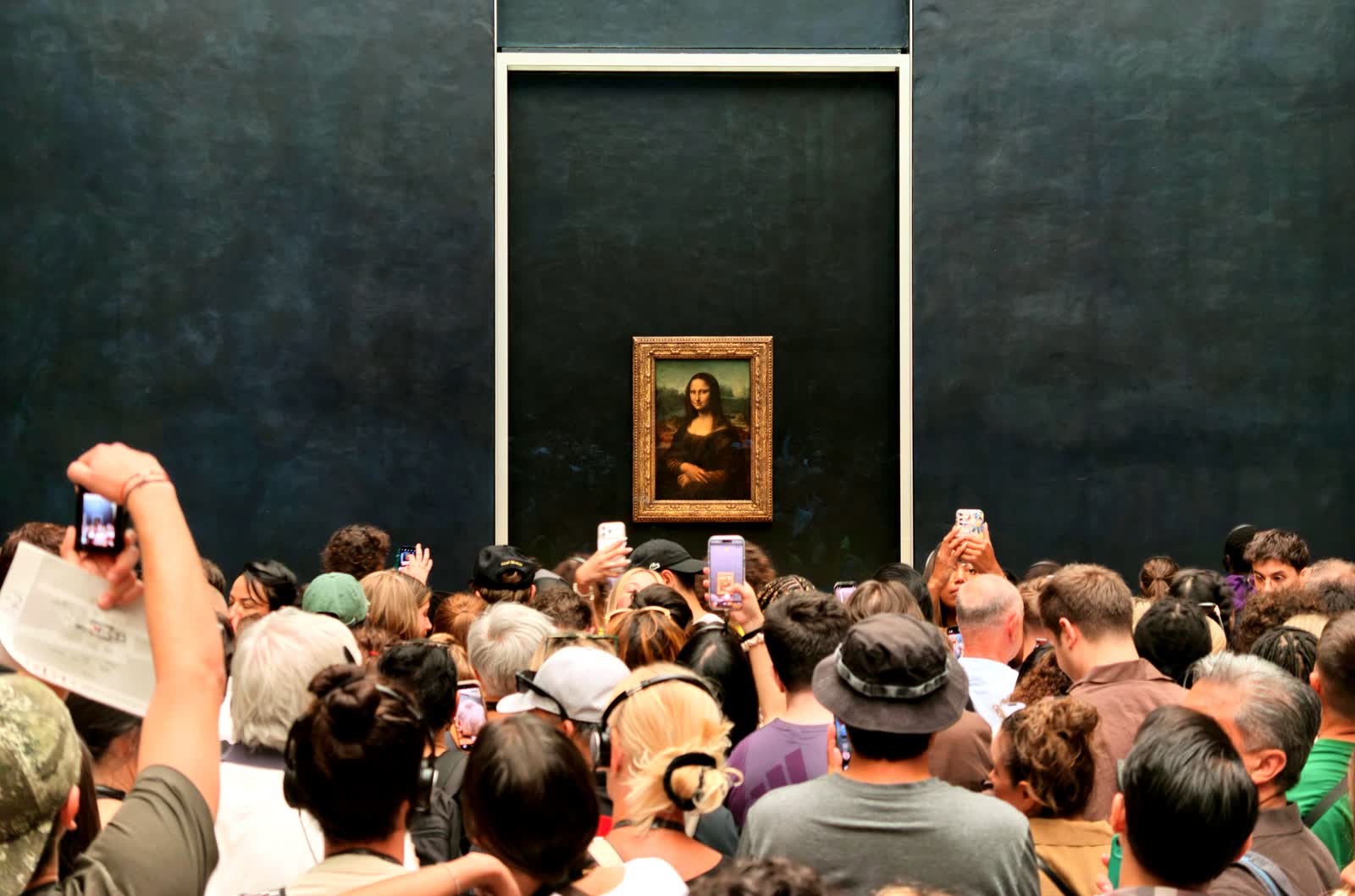
Photo by Obsiv via Unsplash
Last week I was at the National Museum in Oslo, and I entered a room where The Scream by Munch is. I had a floor plan, and on the floor plan, The Scream is in room 60. The room is a large room with a lot of other paintings by Munch. Funny enough, everybody was in front of The Scream, taking photos with their phones and waiting for the person who was exactly in front of the painting to go away in order to take a photo. Completely straightforward. On the right side, there is a guard very close to the wall to be sure that nobody attacks the painting.
Just four or five rooms after, I discovered another famous painting, also indicated on the floor plan, which is a self-portrait by Vincent Van Gogh. Again, everybody was just in front of that specific painting and not looking at all at what was around.
A FOREST OF PHONE SCREENS
Funny enough, in all the museums that own an icon, for example, the Louvre with the Mona Lisa, the crowd stands completely in front of it, and there are so many people that they have to build a kind of slow curve to see it properly. You have tens of screens, like a forest in front of the painting.
Every time I know that somebody has been at the Louvre recently, I always have fun asking them, “Did you see the very large painting just behind you?” Meaning, you’re watching the Mona Lisa, and the painting behind you is a huge painting. Nobody remembers, which is awkward, because when you enter the room where the Mona Lisa is, it’s probably the first painting your eyes cross before seeing the Mona Lisa itself. It’s the Wedding at Cana by Veronese. Because this painting is not known to a large audience, even though it is 10 meters wide, the fact they’ve never seen it, they just don’t see it.
There is a scientific term. When we know exactly what we’re looking for, the mind is going to prioritise it. That is called selective attention, or attentional set. This is when we’re looking for the Mona Lisa or the Scream. But when you’re not seeing anything (for example, the Veronese) because your focus is somewhere else, this phenomenon is called inattentional blindness. Once you discover it, you see it everywhere, which is what we call a frequency illusion, or the Baader-Meinhof phenomenon.
I think we can say that people do not come to see a specific painting; they come to confirm it. The image, which probably comes from the fridge magnet or magazines, is basically what is standing in front of them, and it closes the circle when you see the original.
Museums agree with this because they write it down on the floor plan, telling you where the icons are. You have the signs showing them or telling you which floor it is. This can be very practical because if you have a limited time to spend in the museum, you know exactly where you’re going to find the icons you’re looking for.
THE FIFTH TIME, YOU DOWNLOAD IT
Seeing takes longer. It is exactly like this: remember each time you hear music for the first time, and maybe it doesn’t really talk to you. Then you hear it for the second time, the third time, and the fourth time. Suddenly, the fifth time, you’re going to download it because you needed the repetition to get this familiarity, and it is the same with art.
If you’ve never seen the painting before, discovering it maybe in a museum, you hardly see it. I’m talking to people who are not used to looking at art on a regular basis. If you see it over and over afterwards, even in magazines and in books, then you will go back to the museum and see it properly.
It means that the visitor is walking past paintings that are worth spending time on, but because they don’t know them, they don’t see what reason they would have to stop in front of them. This is, of course, a little problem, but it can be fixed.
I HAVE BEEN DOING THIS SINCE I WAS 12
When I was 12, we went to Florence, and I borrowed my mother’s camera and spent the trip photographing corners and everything. I even remember going up the dome by Brunelleschi and taking a dangerous position above the barrier in order to see and take a picture of the design on the top of the facade. I wanted to have the details, and then I continued with all the Fra Angelico I loved in the city.
In the late 90s, during the internet rush, I co-founded eyestorm, which was the first-ever website selling art online. I did it because I couldn’t understand why visual art was the one form that did not travel to us. You had to travel to it.
We need to build familiarity with art, and it doesn’t come in a few seconds. It needs time. Yes, museums can be the best place to do it because paintings are properly hung, with the best light and so on, but the building doesn’t give you the eyes you need to look at it.
This idea, comparing it to the music industry, was the single idea which I did apply to everything I do: bringing to people the time, the repetition, to become familiar, not calling it at all training or education. And this is how ikonoTV was born: museums deserve to have visitors who know how to look properly at the art they are exhibiting. We provide works that most people have never heard of, without bothering them with labels, a voiceover explaining it, or even music, in order not to entertain and disturb the slow view. Maybe next time people go and see the Mona Lisa, they will turn around in the room and discover with pleasure the Veronese and the other works.
My only question would be for the people who are hanging these paintings and icons in the rooms: no need to bring more people (because I guess they are ready enough to have a quality experience), but what would it take for one of them to walk out with the feeling the painting had on them and maybe even find a way to keep this feeling, always?