

 All articles
Half the Work Is You
Nine compulsory questions about the artwork. Not one about the person standing in front of it.

Elizabeth Markevitchfounder of ikonoTV
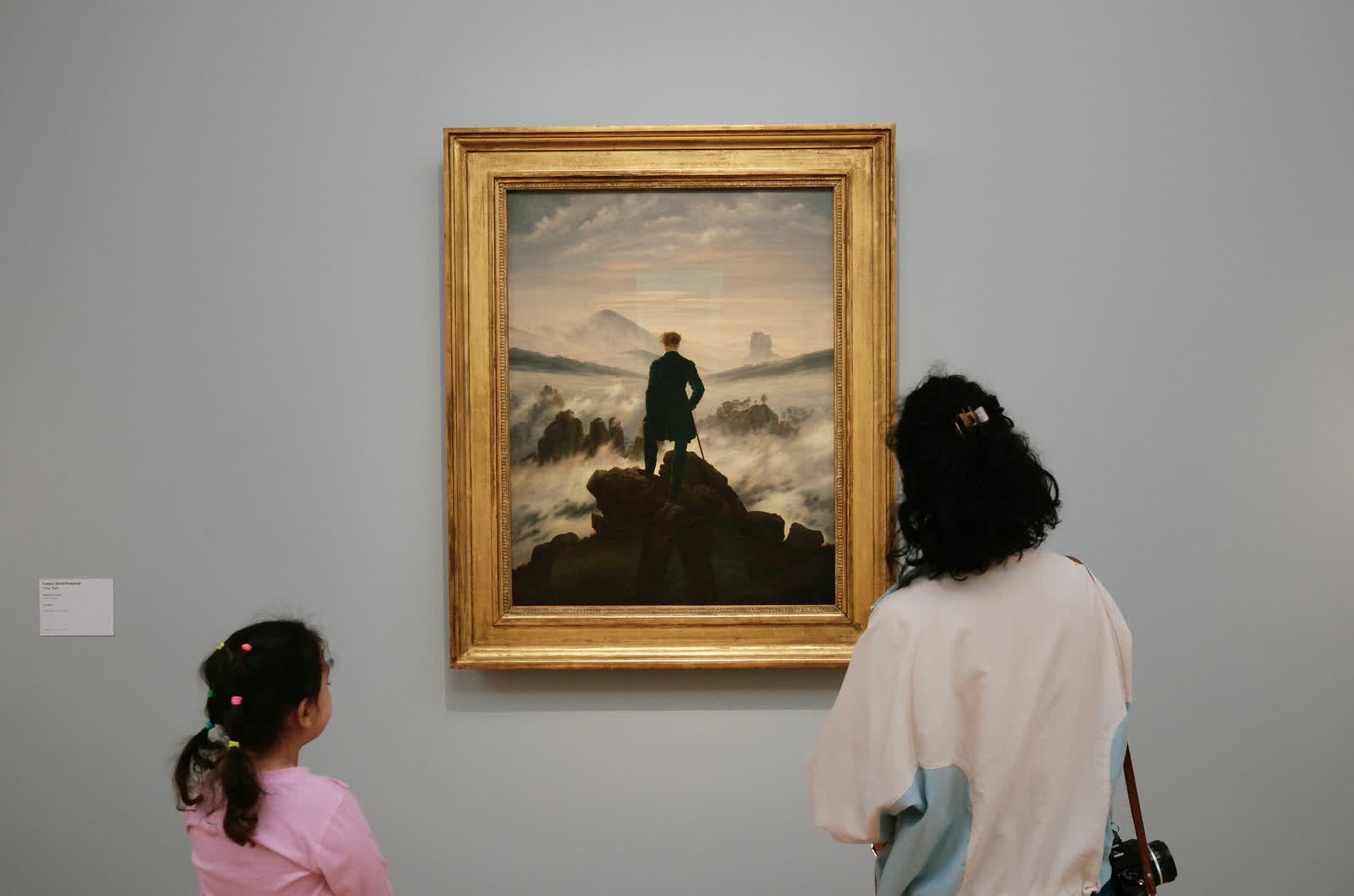
@Onur Kurt for Unsplash
Somebody explained cold data and warm data to me this year, and they did it with a story I have not been able to put down since.
A village doctor goes out to see an elderly patient. He knocks, nobody answers, the door is on the latch, so he lets himself in. The house is dark. In the kitchen, the sink is piled up, and it has begun to smell. He finds the man in the bedroom, sitting in the corner, and before either of them has said a word, the doctor already knows that something here is wrong. Then they talk. The man’s wife died last week. He has never in his life cooked an egg. So the doctor picks up the telephone, calls the municipality, and asks them to send somebody to clean the house and to bring this man a hot lunch every day.
Now put the same man in a city. He goes to a surgery, he gets his ten minutes, and he comes out with a prescription for an antidepressant.
The antidepressant is the cold data. You know the input, you can measure the output, it goes into a spreadsheet. The warm data is the dark kitchen, the sink, the man in the corner, and the wife who died last week. Neither doctor is a fool, and neither is doing anything wrong. One of them was in the room.
When I first heard that, I recognised myself in it so hard it took me days to recover. Twenty years of ikonoTV, everything I have cared about living on the warm side of that line, and I had never had the words for it. It also explained why investors could like me enormously and still not know what to do with me.
And then it explained something worse. My whole field lives on the warm side. Every museum director, every festival programmer, every publisher. And every one of them has been handed the ten-minute version and told to call it evaluation.
Nine questions about the painting
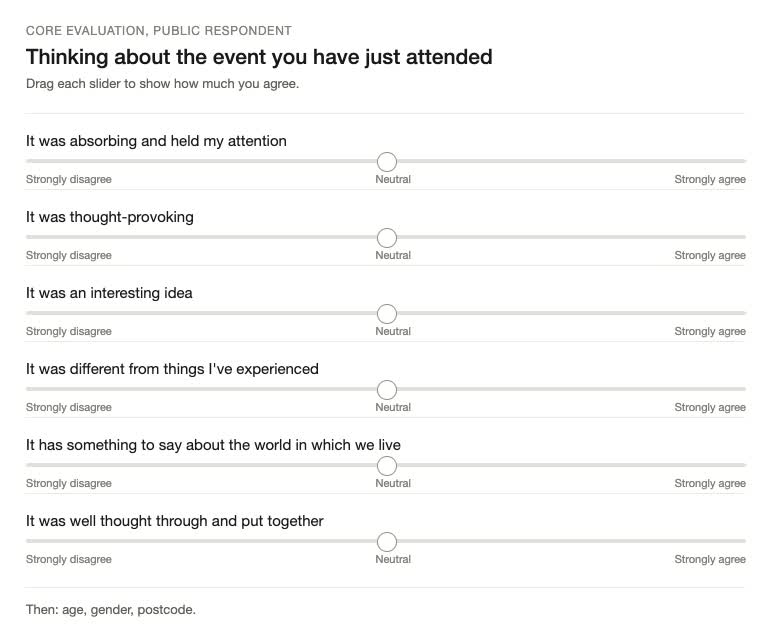
Four times a year, every major arts organisation England funds has to ask its audience what it thought. The core version of that survey carries nine compulsory questions. I have read all nine. Every one of them is about the artwork, and not one of them is about the person standing in front of it.
The instrument is Arts Council England’s Impact and Insight Toolkit, compulsory for the larger National Portfolio Organisations and the most developed cultural evaluation apparatus in Europe, so not a British curiosity. Four of the nine, in their own words. Captivation: it was absorbing and held my attention. Concept: it was an interesting idea. Rigour: it was well thought through and put together. Excellence: it’s one of the best examples of its type.
You answer by dragging a slider from strongly disagree at one end to strongly agree at the other. What the building receives at the end of the evening is a number out of a hundred.
Read those statements again for the grammatical subject. It. It. It. Everyone asks the visitor to appraise the work. Challenge, “it was thought-provoking”, comes closest to an inner state, and even that is a compliment paid to the artwork’s intelligence rather than a report of what happened to anybody in the room.
Every one of them goes to the intellect, and not one of them goes to the heart. The form takes somebody who has just been moved and marches them back up into their head to compose a verdict, which is the one place the feeling never was. It turns every audience member into a junior critic filing a review, and it leaves a director holding a survey of an opinion and not a survey of an audience.
No measures for feelings and emotions
I am not the first person to notice this, and the people who noticed first built the thing. Counting What Counts, the body that runs the toolkit alongside Culture Counts and the Arts Council, states on its own website that “the current selection of dimensions in the Toolkit is missing others that measure the feelings and emotions of those experiencing the work.” That is their sentence, in the present tense, about their own instrument. There is nothing for me to add to it.
So let me be accurate, because the sweeping version is wrong and any museum-studies reader would take it apart in a line. It is not true that the sector never asks about feeling. The Generic Learning Outcomes framework, built at Leicester and used by roughly half of British museums, carries an affective category among its five. It has been there for twenty years.
Look at where it sits. One box in five. Inside a framework called learning, so the organising idea of a person’s encounter with a painting is what they took away from it. And the word chosen for that box is enjoyment. Enjoyment is what you say about a pleasant afternoon. It is not the word for what happens when a painting takes your legs out from under you.
The charge is not absence, it is rank. What is compulsory is the appraisal of the work, and feeling is the module you add if you have the appetite and the budget.
Nobody said the word public
A few days ago I sat on a panel about artists’ rights. Lawyers, artists, a lot of people who have been treated badly, and a long conversation about money, which is fair enough, because most of them are not paid properly. In the whole session, nobody once said the word public. Not one person mentioned the people they make the work for. I came out of it shocked, and I am still a little shocked now.
Duchamp settled this in 1957. The creative act, he wrote, is not performed by the artist alone. The spectator brings the work into contact with the world, deciphers it, interprets it, and adds their own contribution to it. The person standing in front of the painting is not the audience for the work. They are part of it.
Which makes the evaluation form stranger than it first looked. If the encounter is half of the work, then a survey that asks only about the object is not simply missing the audience. It is missing half of the thing it came to measure.
What the form is actually holding
Look at the shape of it. An instrument is pointed at a person. It asks the appraising mind to speak. It finds the appraising mind in good order. It reports that nothing is missing. That is the ten minutes in the city surgery, and it is also the Core evaluation, four times a year, in every funded building in England.
And here is the part that should be harder to put down than a complaint about a missing feelings box. It is not only that the encounter goes unrecorded. What does get recorded is not the thing you believe it is.
“It was thought-provoking” is not a reading of an artwork. It is a sentence somebody composed, afterwards, in words, about something that happened to them in a fraction of a second before any of those words existed. By the time it reaches your form the feeling has done its work and gone. You are not collecting the event. You are collecting the report.
Which means that every Rigour score and every Relevance score in the national dataset is a second-hand account of an experience nobody was asked about while it was still happening. You do not have sound quality data with a feelings module missing from the bottom of it. You have quality data whose provenance you have decided not to look at.
Count what it did
Fine, says the reasonable director. We will add a box for it.
The fix is not a tenth dimension. Bolting a feelings question onto the foot of a nine-question appraisal form changes nothing, the same move as five smiley faces printed on top of the same thirty questions, still long, still extractive, only decorated. It would also still arrive too late. A sentiment question emailed on Thursday to somebody who was in the room on Saturday collects exactly what the other nine collect, a sentence composed after the fact, and puts a feelings label on it.
What is needed is a different question, asked at a different moment, in a different currency. Not what did you think of it. What happened to you, asked while it is still warm.
I have one problem with my own argument, and I have not solved it. The moment you count a feeling you have started to cool it, and a garden of numbers about how people felt could end up every bit as dead as a spreadsheet about what they thought. I do not know how to get all the way round that. I only know that not counting it at all has not worked either, and that the doctor who walked into the dark kitchen was not measuring anything and still knew more than the man with the prescription pad.
So keep the nine. They are good questions about a work of art, and any curator worth the title should want the answers. Just stop calling them a reading of the audience. Count what the work is. Then count what it did.
A question, then, to the directors, and to the evaluation leads and audience researchers sitting beside them. Look at the last set of results that landed on your desk. Do they tell you what the work did to the people who came, or only what those people were prepared to say about the work? I read numbers like those for years without once asking myself which of the two I was holding. If you have found a way to tell them apart, I would like to hear it.