

 All articles
Goosebumps never lie
They read us from the outside while the goosebump was telling the truth the whole time.

Elizabeth Markevitchfounder of ikonoTV
Last week, I ended with a wish: that one day every goosebump would be counted, and counted as part of what culture gives back to us. It is only fair to admit that some people already try.
In laboratories, and out in the field with sensors and clipboards, there are serious researchers who have spent whole careers trying to measure what a piece of music, a film, a room full of paintings actually does to a human being. I admire them. I have followed their work for years, and the more closely I read it, the more I see something that the best of them saw long before I did. It is not a flaw in their care, their ethics, or their intelligence. It is a flaw in the paradigm they were handed. The thing they most want to catch keeps slipping through the very tools built to catch it, and the most rigorous people in the field are the ones most uneasy about it.
What counts as objective
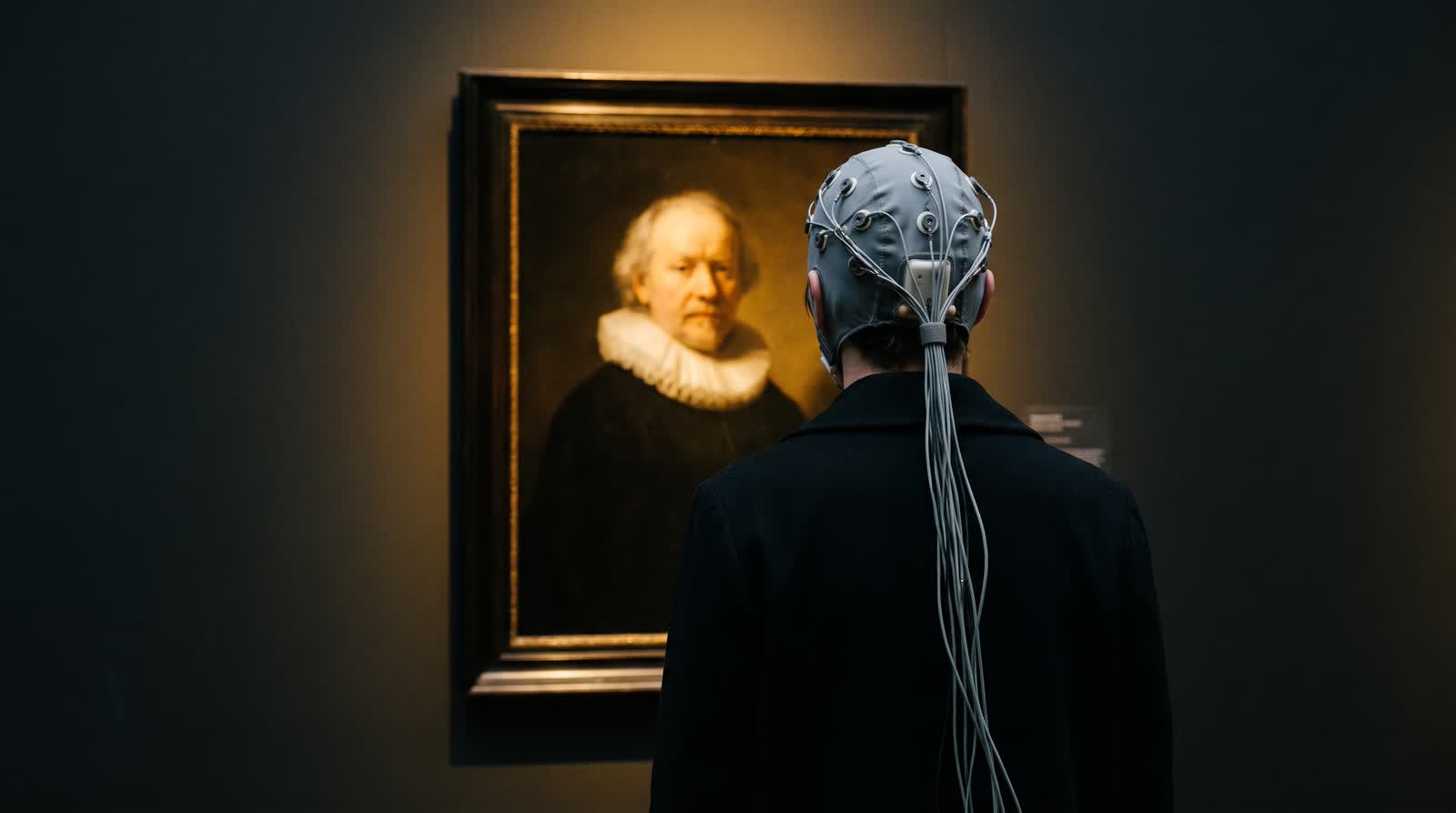
Feeling gets measured with what the culture around the research would call an objective set of tools. That word does a great deal of quiet work, and it belongs less to the researchers than to the system that funds and publishes them. In the hierarchy of evidence that funders reward and journals rank highest, the survey, the simple act of asking a person how they feel, sits near the bottom. It is filed as the soft one, the subjective one, the data you apologise for. Not because the best minds believe it. Many of them built their careers on asking people directly, and have argued, against the grain, that first-person experience is not noise to be corrected but the signal itself. The bias is structural, not personal. What gets called hard, and allowed to count, is the reading taken from the body: the electrical activity of the brain read through a cap of electrodes, the beat of the heart and the tiny variations in the gaps between the beats, the micro-sweat on the skin of your fingers, the cortisol in your saliva sampled hour after hour like a specimen. Objective, in the end, just means harder to argue with. That is not the same as truer.
What the machines actually see
Here is the part that stopped me. Even those trusted instruments do not capture the feeling. They capture arousal. Activation. How switched-on the body is, how loudly the alarm is ringing, never which alarm it is. A racing heart and damp palms look exactly the same in terror and in love. The electrodes on your fingers cannot tell a thrill from a fright. The cap on your scalp registers that you are engaged, not whether you are moved or merely tense. The scanner shows a region lighting up and the temptation is to say, there, that is joy, but the honest scientists are the first to tell you that reading a named emotion off a bright patch of brain is a known trap. Even the cameras that claim to read feeling from your face lean on an assumption that a landmark review of the evidence has seriously challenged, that a smile reliably means happiness, when a smile can be politeness, or embarrassment, or grief being held together in a public room.
The researchers who have looked hardest at this now argue there is no clean fingerprint, no single pattern in the body or the face that maps to one named emotion and only that one. It is still contested, but it is where the strongest evidence keeps pointing. This is why the careful labs never trust a single signal. They triangulate, they cross-check, they hedge, and they are the first to admit that one reading is still missing from the array: the person’s own account, taken in the moment. They have wanted it for years. And still, at the end of all of it, the thing they most want to know, what you actually felt, stays just out of reach of every wire.
The guinea pig
So picture what this looks like from the inside, from the chair. You sit very still. They gel your scalp and fit the cap. They clip a sensor to your finger and strap another across your chest. They ask you not to move while the scanner knocks and hums around your head. They film your face. They ping your phone at intervals to catch you off guard. They collect your spit. All of this elaborate, expensive, patient machinery is pointed at you, to read you from the outside, while you are asked to do the one thing that guarantees they will learn the least: stay quiet and hold still. The care behind it is real. What has gone wrong is not the care but the direction it points.
None of it, not one instrument in the room, is built around you saying, in your own voice and in the first second, what you feel. You are not a person having an experience. You are a specimen being sampled. And the maddening thing, the thing I cannot get past, is that the answer they are chasing with all those electrodes is an answer you could simply hand them. You know. You knew the instant it happened. Nobody asked.
There is an irony sitting right at the centre of the way we fund and rank this work, and it is almost funny. The one method that does the obvious thing, that turns to the person and asks how do you feel right now, is the very method the hierarchy ranks lowest. We have built a science of feeling whose scaffolding treats the feeler as the least reliable witness to her own life, even as the people inside it keep insisting she is the most reliable one we have.
Back to the goosebumps
Come back to the goosebump. Nobody needs an electrode to know they have one. It arrives on its own, up the arms, across the back of the neck, in the exact instant the music opens something, and the person it happens to is never for a moment in doubt about what it means. It is instant. It is unmistakable. It is self-evident to the one who has it and invisible to everyone else, which is precisely why we keep trying to reach it from the outside with machines, when the person carrying it could have told us before the first sensor had even warmed up.
We already are the instrument. Each of us walks around inside the only device that has ever known, in real time and without error, what a piece of art just did to us. We do not need to be decoded. We need to be asked, and given one clean, quick way to answer in our own voice, before the moment cools and the mind begins explaining it away.
That is the whole gap. On one side, rooms full of brilliant people building ever finer ways to read us from the outside, still missing the one reading only we can hand over. On the other, millions of us who have carried that reading all along and have never been given a clean way to pass it on.
My team and I are building that way. It is not a rival to the electrodes and the scanners. It does the reverse. It takes the one reading the labs have never been able to take, the person’s own fast answer, in her own voice, at the scale of thousands at once, and hands it back as the missing signal that completes their triangulation. For the researchers I have followed for so long, this is not a disruption of their work. It is complementary to it. I am not ready to show you yet, but it is closer than it was the last time I wrote to you. More soon.