
 All articles
35 Seconds a Scene
The Art Newspaper's critic walked the Bayeux Tapestry at the British Museum in 35 minutes, across 58 scenes. We produced a 47-minute film lets you meet the tapestry before you queue.

Elizabeth Markevitchfounder of ikonoTV
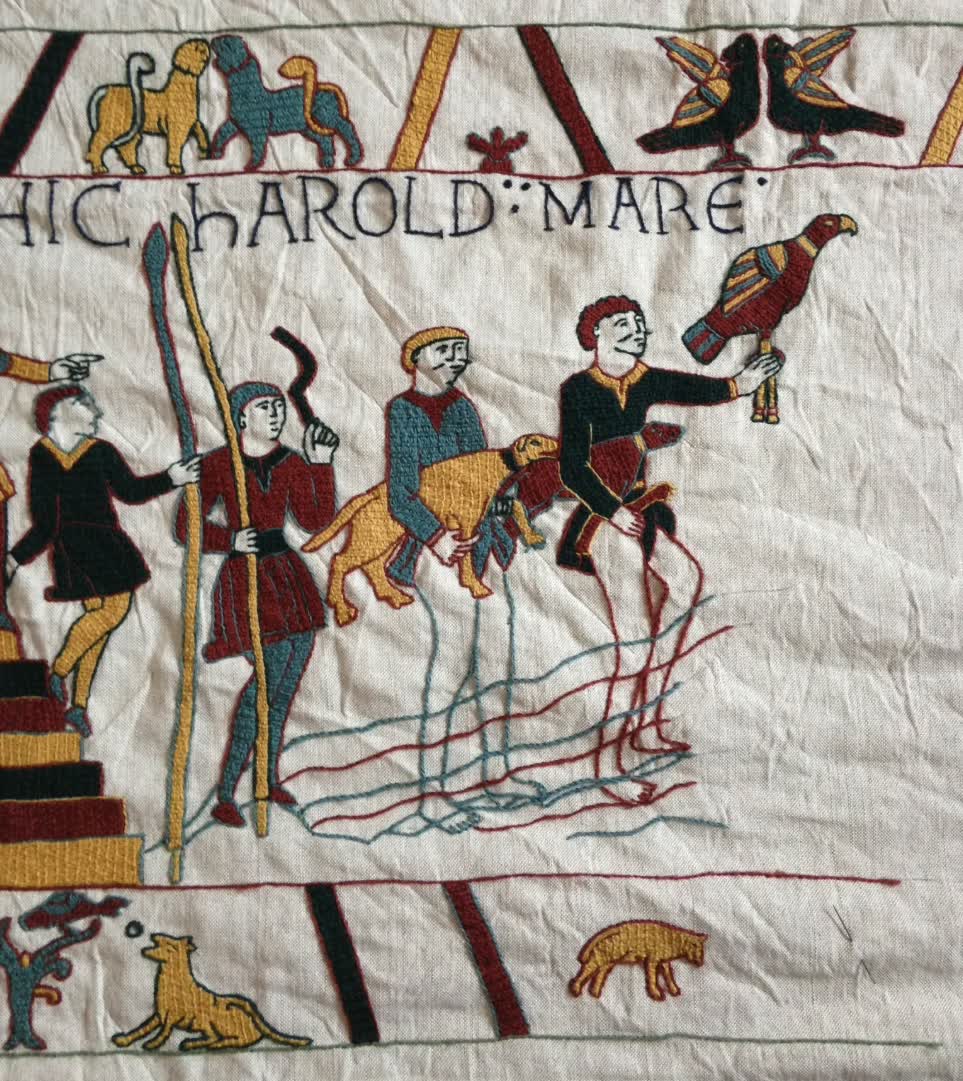
There is a man on the Bayeux Tapestry who is carrying his dog to a ship. He wades out into the sea with a hound held up in both arms, so that its paws stay dry.
He is not part of the story. The story is an oath and an invasion, and the dog has nothing to do with either of them. Somebody stitched him anyway.
Jonathan Jones of the Guardian noticed him too. Among the details Jones savours is “one of Harold’s people carrying his hunting dog to a ship so it doesn’t get its paws wet”. A critic with a whole invasion to write about stopped for the dog. Most visitors will not get the chance to stop.
The tapestry is in London
The tapestry is at the British Museum now. It is on loan while the museum in Bayeux is rebuilt, and it is on show from 10 September 2026 to 11 July 2027. Then it goes back. It is 68.3 metres long and about 50 centimetres high, with 58 scenes. It was stitched in the 1070s. The museum expects about a million visitors over the run. Tickets have been hard to get.
The reviews have been glowing. Time Out gave the show five stars, and Andrzej Lukowski called the cloth “extraordinary: sacred, profane, childish, profound, defining of our world but utterly unworldly.” City AM gave it four. Jones wrote that its makers “created something so stupefying and delightful, so abundant in visual thrills, horrors and humour, it beats almost everything else ever painted or carved”.
Artnet described the room at a press preview: “In a luminous glass showcase, the embroidery unfurls along a narrow, darkened hall. At a press preview, visitors swarmed to the light like moths, shuffling its length slowly, in near reverential silence.”
Keep that picture in your head. It is about to matter.
Then a critic did the sum
Martin Bailey reviewed the show for the Art Newspaper on 11 September. He queued for 20 minutes to get in, and for another 25 in the main queue. Then he walked the tapestry in “a long line of around 100 visitors”. “After 35 minutes we had reached the end.” With a standard ticket at £33, he made that “almost £1 a minute”. And then the sum: “And with 58 scenes, it was 35 seconds for each.”
An announcement every two minutes urges people to “keep moving”. Bailey still found the show memorable, and called it “remarkably well planned and organised”. I want that on the page. The pressure he describes is the announcement and the line of visitors around him.
Apollo had run a sum of its own before the doors opened. At 40 minutes, it said in May, “each visitor has about 34 seconds to move along the work in 7cm intervals”. That counts the tapestry in 7cm steps, where Bailey counts scenes, so I will not set the two figures side by side as if they agreed.

The museum’s side
The museum has an answer: A museum source told the press that the 40 minutes assigned “is a lot longer than people get in Bayeux”. Apollo adds that visitors there will get 25 minutes when the museum reopens in 2027. That may well be true. A longer slot than Bayeux may still leave little time for each scene.
What fits into one scene
So here is what goes by in Bailey’s 35 seconds.
Harold is seized, and a hand closes on his forearm. Directly beneath, in the same column of tapestry, two men with clubs drive a stag forward into a pack of hounds. The tapestry put those two things one above the other. It does not say why, and I will not say why for it.
Later, beneath the newly crowned Harold, four ships sit in the lower border. They are drawn in outline with nothing inside them. Everything else on the tapestry was stitched twice, once to draw the shape and once to put the colour in. These four were left at the first stage, at the point where the story has to say what happens next. The British Museum offers three readings of them in one paragraph and picks none. Whether the wool was never put in or was lost later is not settled either. I would rather say so than tidy it up.
A man called Turold holds two horses and has his name stitched over his head. Only three women appear in the main register, and only one of them is named, Ælfgyva. The Latin sentence about her has no verb, so nobody knows what it is telling us.
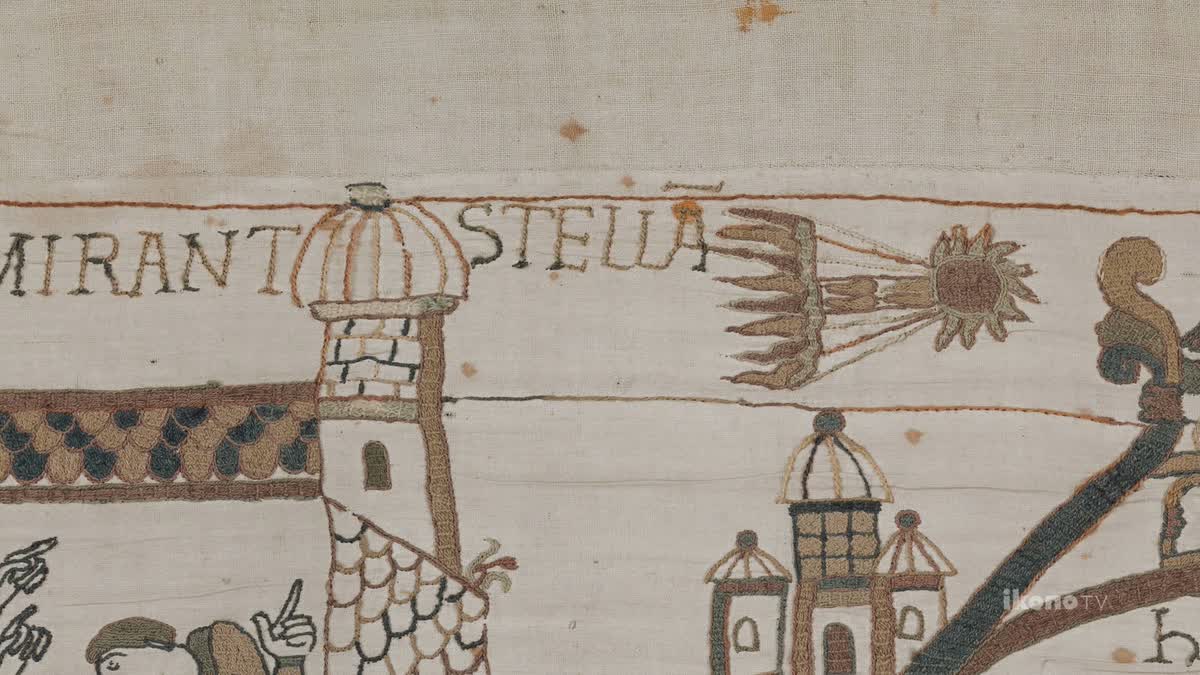
And the borders. For most of the tapestry they are lions, griffins, dogs and birds, each in its own panel between its bars. Jones thought he had found a system: the top margin more ordered and heavenly, the creatures below earthy and sinful. “Then I saw two bare-chested female centaurs at the top spreading their arms out as if to say: ‘Lo and behold!’ So much for logic.” Then Hastings arrives. The animals run out, the bars run out with them, and the lower band fills with bodies, fallen horses and mail being stripped off the dead.
The first time I saw this man with his dog, a friend of mine pointed him out to me. In all of this 68-metre tapestry, he really looks like the tourist. He is an outsider, and it is quite fun to look at him and follow him. He always comes back, so I always did like him.
None of this survives a walk like Bailey’s. The dog does not either, unless you already know he is there.
Look first, read later
I am a great believer that when we go to a museum, the way not to feel lost is to look at a work of art first without any intellectual input. Let yourself feel the work first. Once you see it in real life, you have what Walter Benjamin called the aura, and the aura exists only when you are facing the work itself. You can still enjoy it, and react to it, in front of a screen or in a book. I hope our work makes people enjoy their visit better, as every second is counted.
So we filmed it slowly
So we filmed the whole tapestry slowly. ikonoTV, which I founded in 2006, has spent twenty years asking people one thing. Look at this for longer than you meant to.
The film is made inside many high-resolution photographs of the real tapestry, and the camera moves through it. It goes in, it travels, it stops. Nothing is drawn, nothing is generated, nothing is added. No creature in a border is ever cut in half by the frame. It is silent. There is no voice and no music, because the tapestry has none. A voice would tell you where to look, and that is the one thing worth leaving to you. The borders only show up when nobody is talking over them.
The story of the opening scenes is the animals. Harold rides out with a hawk on his fist and three hounds running at the horses’ feet. When the land runs out, the men pick the animals up and carry them into the sea. The longest hold in that stretch of the film is on a man wading into the water with a dog in his arms. You will meet him early.
There are two ways to see it. The whole tapestry runs for 47 minutes on ikonoTV, silent, end to end. A cut of 30 minutes is in the Slow Art app, made for meditation. It stops before the battle, so it settles you and ends before the violence arrives.
What I would do
Here is what I would do. Watch the long one before you go, on a screen where you can stop it whenever you like. Pick out two or three things you want to find. If your walk is like Martin Bailey’s of the Art Newspaper, you will have about 35 seconds a scene, and that is enough time to find something you already know is there. That is one critic’s walk, not a promise about the room. Nothing on a screen replaces standing in front of the real linen, and this does not come round again. Go.
A word about the arrow
One thing I should say plainly. The passage everyone comes for, Harold and the arrow, is largely an 1842 restoration. The arrow is not in the earliest drawings of the embroidery, and the caption about the English fleeing was added around 1814. Look at it, and know what you are looking at. I would rather tell you that than let a beautiful moment claim more than the linen can.
I really wish everybody a fantastic experience. Enjoy this amazing tapestry and piece of history, in an extraordinary museum, after discovering our slow art video.
Somebody stitched that dog a very long time ago. Give yourself long enough to find him.